
Rekindling Alliance
How do we remain in relationship?

Please continue to share, comment, reach out.
Thank you. Your engagement is what helps grow the audience.
An important note: this essay reflects on difficult questions around identity, history, race, racism, antisemitism, power, and Israel — topics that can evoke strong and deeply personal reactions. The fellowship discussed in this piece is not centered on political alignment around Israel, or any other specific subject. Politics are not the point. Relationship is.
This fall, I will launch the Chicago chapter of Rekindle, a national fellowship to spark and facilitate Black-Jewish dialogue.
“I’ve been talking to people about it,” I explained to the national rep during an orientation call. “But I don’t know the answer to the question: Why?”
Honestly, I understand why now.
But I’m not sure I understand why.
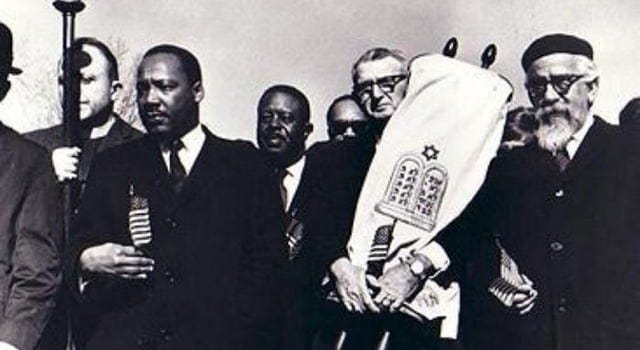
And she reflected on the sense of alliance that once existed, the image of a Rabbi Heschel marching with Dr. King. A generation that understood itself through solidarity and shared struggle.
Not only oppression,
but the striving for redemption.
For reparations.
For recognition.
“But what about young people?” I asked.
I understand instinctively the connection between our elders. I inherited it, too.
But it’s a different generation now.
What have they inherited?
And what are they building from it?
…
I was raised with a particular story about Israel: pioneering, socialist, redemptive. A place that turned desert into fertile land, re-birthed a dead language, created sanctuary for the oppressed.
I am at the tail end of a generation raised on Holocaust survivors. There were still so many alive during my years of religious education leading up to my bat-mitzvah. Their stories cast Israel as refuge, miracle, and moral project all at once.
My nieces and nephews— now in their 20s and 30s— were raised with that same story in Hebrew School, but came of age in a different world entirely, with very different headlines.
Through them, I’ve come to think differently about Jewish identity. Less tied to land and statehood than to ethics, history, ritual, culture, community.
Diasporic.
Portable.
Interpretive.
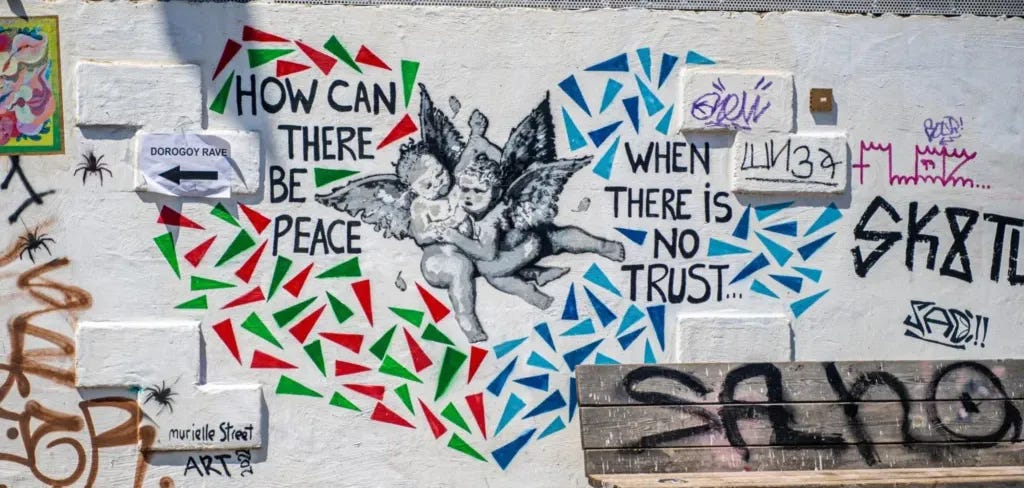
I have begun questioning what it means for a people shaped so profoundly by exile, persecution, and statelessness to wield military, political, and cultural power of its own.
What happens when refuge becomes nationhood?
When survival becomes power?
My nieces and nephews inherited something different than me:
not Israel as the answer,
but Israel as the question.
And increasingly, I find myself living inside the question as well.
…
I’ve been engaged in Black-Jewish dialogue long before I had language for it.
I was brought into Jewish community at Rodfei Zedek on Chicago’s South Side, in Hyde Park. Rodfei Zedek— literally translated as Pursuers of Justice— raised me to believe that Judaism was synonymous with social justice. In my home hung a print:
Tzedek, Tzedek tirdof.
Justice, Justice you shall pursue.
If my father had a motto, that would be it.
At Hyde Park JCC day care, summer camp, and afterschool programming, the neighborhood’s demographics— roughly 50-50 Black and white— were clearly reflected. I have a picture somewhere of a childhood friend, still in my life, lighting Shabbat candles beside me at camp on a Friday afternoon. He’s Black, I’m Jewish, and we were hugging while we sang.
In 2nd grade, after a public school teachers strike, I returned to Akiba Schechter Jewish Day School and was the only white student in my grade. The school also served the Beth Shalom B’nai Zaken Ethiopian Hebrew Congregation, blending Jewish traditions with African-American culture and the Hebrew Israelite faith.
During those same years, Operation Solomon was bringing thousands of Ethiopian Jews to Israel. We were taught to be proud; to embrace these members of the Tribe.
I was raised on stories and photographs of Rabbi Heschel marching beside Dr. King in Selma. My parents protesting in the streets of Chicago with small children. Judaism, as I inherited it, was not quiet. It was active. Public. Moral.
But it wasn’t the only story about that solidarity.
In fifth grade, when I briefly had a Black boyfriend— one of those relationships mostly negotiated by friends and lasting all of two days— my mother scolded me and told me it wasn’t allowed.
“It’s hard enough when you’re alike,” she said.
Years later, I immediately understood what Obama meant when he described a certain kind of racism in his White grandmother— someone who loved him deeply, but who was also afraid of strange Black men on the street.
I wouldn’t say my parents weren’t racist. Or aren’t. But it’s a spectrum. And contradiction.
And then there was Hyde Park itself: a Black political powerhouse alongside a deeply rooted Jewish community like my own. Obama. Carol Moseley Braun. Jesse Jackson. Toni Preckwinkle. Black-owned mansions beside University of Chicago Nobel Prize winners. My grandfather immigrated directly to Chicago’s South Side.
The alliance I inherited was aspirational.
It was about shared striving, shared values, the belief that communities shaped by exclusion might recognize something in each other— and honor each other’s paths toward success, legitimacy, safety, belonging.
The Black-Jewish relationship I inherited was not primarily framed around mutual wounds, but around mutual overcoming.
Education.
Political power.
Institution building.
Generational mobility.
Not an alliance born primarily from grievance or accusation.
That’s part of what feels different now.
So much of the current conversation begins not from shared possibility, but from fracture.
From resentment.
From negotiations over pain, power, obligation, betrayal.
…
I am one of those American Jews who didn’t think antisemitism really existed in the US.
Sure, I knew about the fringe crazies, the tiki-torch marchers. But I never believed those who said it was sitting just under the surface. My experience had been the story of American Jewish success.
I’m not an October 7th Jew, struck primarily by the violence of that day.
Nor am I an October 8th Jew, transformed by the global response afterward.
“I’m an 18-month later Jew.”
It wasn’t October 7th, or even the war in Gaza, that moved me most. It was the sustained presence of the conversation. The pervasiveness of the protest.
That’s when I started wearing my Hebrew name in gold around my neck.
לֵאָה טוֹבָה
In Judaism, we are given our religious name in ceremony. It is the name used when we are called to ritual, announced as daughter of, followed by the names of our parents.
To be Jewish is to understand yourself as tied to the past— to ancestors, stories, obligations that precede you.
“I never would have worn something Jewish so openly,” I’ve explained more than once. “But now I feel an urgency to wear my Jewishness out loud.”
I haven’t become afraid.
I’ve become adamant.
It wasn’t shame that stopped me before. I’m proudly Jewish. I embrace and honor the sabbath— not to honor G-d, but to use ritual as a way of holding community and carrying the past into the present.
But visible Jewishness had always felt unnecessary to me.
It was something I inhabited, not something I felt compelled to announce.
…
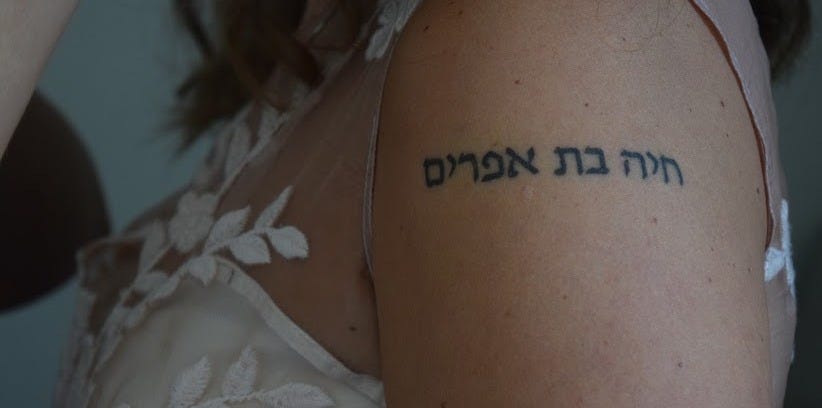
About a year before October 7th, my friend Kate had a tattoo removed from her shoulder.
Chaia bat Ephraim.
Chaia (Kate), daughter of Fred.
A tribute to her father.
“I have a feeling,” she said.
In 2017, tiki-torched marchers had filled the streets of Charlottesville, chanting “Jews will not replace us”, while the President insisted there were “good people on both sides.”
Later that same year, she marched in protest in her home city Tacoma against a tattoo artist who openly identified as a proud Nazi.
Then there was Tree of Life.
Poway Chabad in San Diego.
The list goes on.
So she covered the tattoo.
She knew I thought it was silly.
I still do.
She doesn’t.
…
For years, conversations about antisemitism had existed mostly at the edges of my awareness.
Then suddenly they seemed everywhere.
Not only because of Kanye West’s outbursts, though certainly those became part of it, but because the conversation no longer remained confined to obvious extremists or isolated incidents.
It spread outward into culture, workplaces, friendships, activist spaces, social media, comedy, universities.
A lot has been said since.
And loudly.
Around that time, I participated in a virtual panel conversation with Black and Jewish leaders in the music industry. During the discussion, many Jewish participants expressed some version of the same shock:
We’ve been there for you.
How could you abandon us?
And I raised my virtual hand to share: as Jews in America, we experienced extraordinary success. I wonder whether we became so focused on securing our own place that we stopped thinking about who else still needed a hand up— particularly our Black colleagues and friends— forgetting that handouts are not the same thing as solidarity.
Afterward, several Black colleagues reached out privately with gratitude.
Some conversations only begin once someone is willing to say aloud the thing everyone else is carefully circling around. Otherwise “coming together” becomes an act of politeness. Performative.
Not transformative.
…
And then came Chappelle’s SNL monologue:
“If they’re Black it’s a gang.
If they’re Italian it’s a mob.
And if they’re Jewish it’s a coincidence and you should never speak about it.”
The line itself didn’t shock me nearly as much as the reaction to it. Jewish outlets and organizations responded with outrage, hearing echoes of old conspiracies about Jewish control and influence.
The joke circled terrain many people feel unable to discuss honestly: money, power, success, influence.
American Jews, despite being such a tiny percentage of the population, have become highly visible in leadership across academia, media, law, politics, finance, and philanthropy.
Sometimes that success is spoken about with admiration.
Sometimes with resentment.
And sometimes it mutates into conspiracy.
For so much of my life, being Jewish felt like blending in.
Now, it feels like standing out.
Success alters not only how a people move through the world, but how the world imagines them.
What happens when, within just a few generations, a people move from statelessness and extermination to perceived proximity to power?
…
Years ago, a friend who is both Black and Jewish explained:
“I move through the world as Black. People don’t look at me and know I’m Jewish. I live my Jewishness at home.”
Another friend once described his two Black sons— one embracing both identities openly, the other rejecting the Jewish one almost entirely. Not because he wasn’t Jewish, but because Blackness was the identity the world assigned him first.
I’ve thought about those conversations often lately.
For so much of my life, Jewishness felt optional in public.
Something I could reveal, emphasize, soften, announce, conceal.
That feels different now.
I think of what Black friends have explained for years— what it means to move through the world carrying an identity that arrives before you do.
A reminder of the difference between choosing visibility and having it imposed upon you.
I still have the option to hide.
That distinction is part of why this alliance matters.
Not because our experiences are the same.
But because they are not.
…
A few months ago, I attended a dinner that was part of a Chicago-based initiative around “Black-Jewish Alliance,” similar to the national effort I’m preparing to launch here this fall.
It had existed informally before October 7, but became more intentional afterward.
The premise of the evening revealed itself quickly:
We marched with you for George Floyd.
Where were you for us after October 7?
And in response:
Where were you before George Floyd?
A mutual betrayal.
What happened between Selma and George Floyd?
So much of the evening felt shaped by the language of activism itself— asking us to arrive first as representatives of identities, grievances, obligations, before simply as people.
Black. Jewish. Oppressor. Oppressed. Donor. Activist.
I came to that table certain in my identity, even as I’ve become increasingly uncertain about my role inside it.
“I’ve raised money to support Black and Brown communities for years,” I said. “And from inside fundraising, it often feels like philanthropy gives just enough to maintain the status quo— enough to do something, but not enough to truly change anything.”
Why haven’t we, the Jewish community, done more?
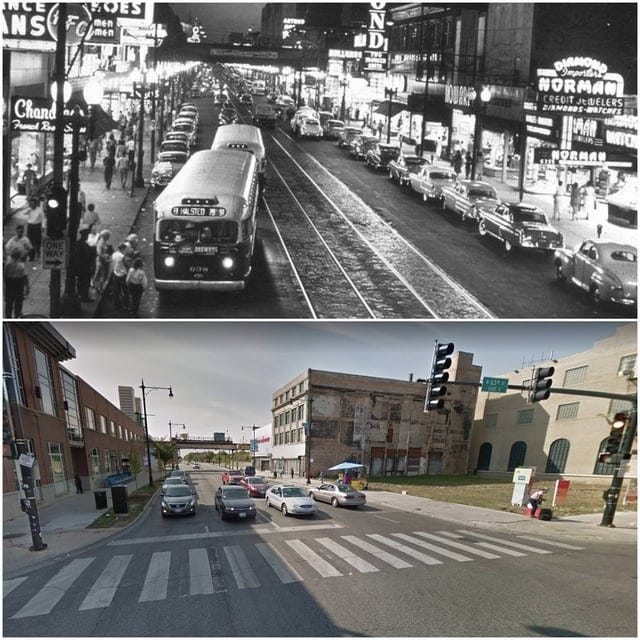
Black participants spoke openly about disinvestment, violence, white flight, neighborhoods abandoned by institutions and capital. Much of it echoed my own frustration.
Jewish participants spoke with equal intensity about feeling abandoned by communities they believed they had long stood beside.
The dinner felt almost therapeutic: resentment, admiration, hurt, connection, all spoken aloud.
But it wasn’t just emotional.
It was a conversation about power.
Who is seen as having it.
What does it mean to share it.
Who feels abandoned by whom.
But it wasn’t until I left that I realized what hadn’t been said aloud.
Not one Jewish person had asked:
Why should it be Jews— or Jewish money— to help?
Where are your people? Your money?
And yet I know those questions exist.
I’ve heard them whispered too many times not to.
At my own dinner table.
In activist spaces.
On podcasts called racist.
The questions themselves are not the danger.
What makes them dangerous is when they calcify into accusation instead of inquiry. When they become a reason to retreat from each other rather than move closer.
In fact, it was the absence of the question that felt accusatory.
…
I shared this story days later with a couple of colleague-friends, still unsettled by that dinner. Still frustrated from all those years of fundraising. Still disappointed by what felt, to me, like an absence of honesty.
Because the question isn’t simply: why don’t you help more?
It’s also: what does help actually look like?
One woman— whom I had just met— jumped in immediately:
“Why do we have to give? How dare you say we don’t give enough. This is their money. They can do what they want with it and shouldn’t be scolded for not giving more.”
As she spoke, she moved quickly between them and us, both meaning Jewish people.
We are “we,” even when we profoundly disagree with each other.
I know many Jewish donors in Chicago feel disillusioned— having given for years to the South and West Sides only to feel scorned, dismissed, betrayed.
I have colleagues who have left the boards of progressive institutions because they felt antisemitism had seeped in. They felt criticized for not giving enough, and then criticized again for withdrawing support once they no longer felt welcome.
“I gave because I believed in the work. Because I believed in the mission,” one friend explained. “But eventually it felt like my donation was being seen not as generosity but as an obligation.”
Judaism says we have an obligation to give. Who decides who we have an obligation to give to?
I believe his hurt is real.
And I also believe many people inside progressive spaces— not only Black leaders or communities— see generosity without transformation. Support that sustained institutions, but never fully shifted who held power, safety, ownership, stability.
…
During COVID, Shabbat became an even more important practice to me.
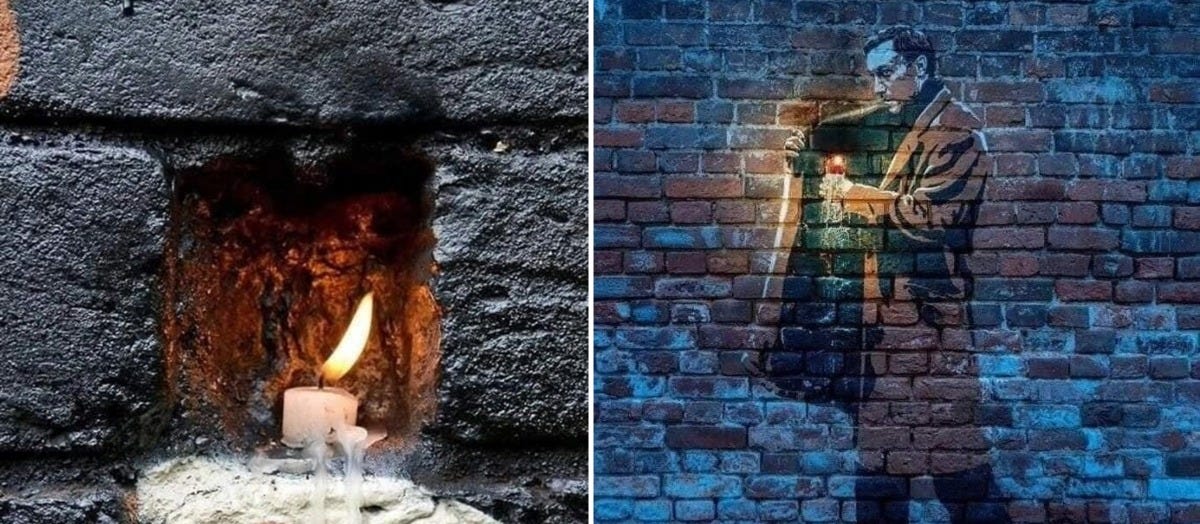
On Friday nights, I would invite our community to gather outdoors. We would light candles, everyone would bring their own wine, their own bread, and together we would say the sacred prayers— pausing, in ritual, to reflect on the past week while looking toward the next.
In a time of so much distance, it literally brought us together.
After George Floyd, though, Friday nights took on a different hue.
Just before Juneteenth, I was in West Garfield Park with a colleague, walking through the neighborhood shortly after its only supermarket had been looted and announced closed. There had been nearly 100 shootings in one weekend, and West Garfield Park was at the heart of that story.
It was Friday afternoon.
While I was preparing to welcome my community outdoors for ritual and gathering, this community was turning inward— closing doors, pulling down gates, blocking windows. Friday night in Garfield Park marked the beginning of another weekend of anticipated violence, while in my neighborhood it marked ritual, rest, candles, peace.
“Judaism has so many constructive traditions,” my friend observed.
He was speaking specifically about grief, about what communities inherit and normalize under pressure.
And we talked about the seven-day shiva ritual practiced by Jews after death— structured mourning, meals arriving at the door, prayers repeated, community gathering daily around grief.
And then about the cycles we were witnessing in communities most impacted by street violence: memorial gatherings centered around drinking, drugs, retaliation, survival.
That pastor changed my life during that brief walk. I had never thought in those terms before— constructive versus destructive containers for grief. Constructive versus destructive practices.
And I could immediately feel how dangerous those words were.
Not because they were entirely untrue, but because conversations like that so quickly collapse into accusation, stereotype, blame.
I know how easily that happens.
I have spent years working in communities most affected by violence, trying to hold two truths at once: that cycles of violence can be understood without being excused, and that the people living inside those cycles cannot be reduced to them.
The harm is real.
The conditions are real.
The stereotypes, sometimes, are real, too.
And once a story takes hold about a people, it becomes difficult to loosen.
That is where the conversation with Jewishness becomes more complicated for me. Israel is not “my people.” And also, I cannot pretend it has nothing to do with how Jewishness is now seen, questioned, defended, accused.
I also cannot pretend how much it is affecting my sense of my own Jewishness.
…
I’m taking on the role of leading the Rekindle chapter in Chicago not to rebuild an old alliance, but to help imagine what a new one might be.
Not to return nostalgically to Selma,
or repair some imagined golden age.
But to navigate the harder questions that emerged afterward— as power shifted, communities changed, and the moral clarity of earlier movements gave way to something far more complicated.
Yes, we need each other most when times are hard.
And this is a hard time.
But why this specific alliance?
Not because Black and Jewish experiences are the same.
They are not.
Not because we always agree.
Clearly, we do not.
And not because either community owes the other permanent loyalty.
But because both communities know something about what it means to be spoken about as a singular “we” (or perhaps more accurately: “they”)— shaped by histories, fears, violence, success, resentment, survival.
How do we share the best parts of ourselves and still acknowledge the worst?
How do we refuse collective blame without refusing collective responsibility?
And how do we remain in relationship— to build stronger ones— while asking those questions honestly?
…
About Rekindle
Rekindle is a national fellowship that brings Black and Jewish participants together across generations, professions, experiences, and perspectives.
It creates space for honest conversation, complexity, disagreement, and the possibility that new forms of understanding and relationship can still emerge.
The work begins from the recognition that there is no singular Black perspective; no singular Jewish perspective. People within both communities are wrestling deeply—and differently—with the questions of this moment.
I’ll be launching the Chicago chapter this fall. If you’re interested in participating, or know someone who is, please reach out to me directly.
Learn more at Rekindle Fellowship.
Great piece- so much I feel aligned with, and perspectives and framing that I find insightful - appreciate how you braid your personal journey with the Black and Jewish community questions, challenges, and struggles.