
The Region is Ready
Does peace demand a war?

It’s not above the fold,
but it’s humming beneath everything.
My friend texted today to let me know they can jump on the phone after all.
He’s delaying his trip back to Israel.
“War gearing up too much,” he wrote,
followed by a barrage of WhatsApp links and images.


…
I do not hide that I have strong feelings about the State of Israel.
Strong feelings, loosely held.
I was raised with an element of Zionist propaganda— the reality of a 40-something-year-old US Jew who attended Hebrew School at a conservative US synagogue.
I believe some of that propaganda to be true.
But what most resonates from my religious education was meeting Holocaust survivors.
Sometimes intentionally—
sitting on a chair before a group of children telling their stories.
Sometimes un intentionally—
like when someone nearby would lean over to whisper, motioning gently toward the tattooed numbers upon a wrist.
There’s a level of solemnity and respect.
An awe for having lived through such a thing.
I won’t describe it as sexy, but it has a pull that feels uncomfortably intimate.
I believe I know something about your secrets,
and I want to know more,
but I know that you’ll never be able to capture what it was,
and I’ll never be able to understand what it could have been like.
How.
How did it happen?
How did it feel?
How did you survive?
How do you go on.
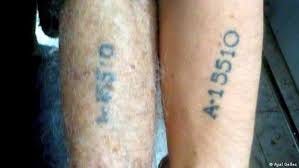
My daughter does not have access to Holocaust survivors—
that generation has almost completely passed.
But yesterday she came home from school with The Diary of Anne Frank. This was unprompted— the Holocaust has not been a topic at home or school.
Last night she asked me to lay with her, and with the lights off cuddled up to me and, voice shaking, started asking the questions:
Why?
How?
We talked about ICE, and how easy it is to watch as people’s rights are stripped away. As human beings are painted as monsters, as other.
“Are there still Hitlers? Still the Hitler family?” she asked. “Because if there are, I want to kill them.”
“Why should they be judged because of the actions of their great-grandfather?” I asked.
She was quiet for a moment.
“Trump helped bring the hostages home,” she said.
“And he also has ICE taking people away from their families.”
I don’t know where she would have learned that.
It wasn’t a question—
just something she had heard somewhere and was trying to hold at the same time.
“Good people can do bad things,” she concluded.
And she snuggled closer to me and settled into stillness in a way that felt too heavy.
…
“It’s not on the landing page of any of the U.S. papers…” I said to my friend, referring to the articles and headlines about warships gathering in the Middle East.
Our conversation wandered quickly.
“No one here is talking about it,” I said.
“In Israel,” he said, “everyone is talking about it. But no one is saying anything—because war is the norm.”
War in the region is both the norm and always exceptional.
This could be The War—the kind that doesn’t stay contained.
“The region is ready,” he said.
…
I’m in the middle of a project focused on the Middle East, and these conversations have become the texture of my days—voices from the region, from those who study it, from those who have left it.
They’ve been unsettling and grounding at the same time,
loosening some convictions and tightening others.
Earlier that morning, I had been on the phone with a colleague in Morocco. She wasn’t talking about the crisis, but about a longer horizon. About how, after the Arab Spring, Morocco rewrote its constitution, repositioning itself from an Arab country to a multicultural one that maintains its Muslim heritage and identity.
She talked about diasporic culture and connection.
“You can’t even tell where Morocco starts and Andalucía ends,” she said, gently tracing the complicated history of thousands of years of migration. “You go to the Alhambra in Spain and see the architecture, but in the bookstores, you don’t see the writings and insights of the Jewish and Muslim scholars.
“But this is changing.
“We are reimagining the region—one of civic diplomacy, complexity, and tolerance.”
She paused.
“The region is ready.”
…
When he said it, readiness meant war.
When she said it, readiness meant peace.
Does peace demand, first, a war?
…
Not everyone I spoke with framed the question in moral terms.
Another colleague, a businessman, spoke about the geopolitical realities, the socio-political history, the complexity and nuance of the region.
“The world is obsessed with this one small border between Israel and Gaza,” he lamented.
He is fervently pro-Israel.
And fervently pro-Palestine.
And fervently frustrated that, as a businessman, this narrative is so destructive to his bottom line.
“The Arab Accords brought more peace to the Middle East than anything in modern history. Why?!” he asked in that cliche way of Jews, with the shoulders and eyebrows raised and hands open to the above.
“Because of business. We do not tell the story of business. The politics of business wants peace.”
The conversation drifted to a conversation of characters.
Bibi and Trump. Khomeini and Putin.
Who might pull who into what, and why.
“Peace will not come from belief,” he said. “It will come from alignment.”
And we consoled each other.
The hope for change and the fear of it.
…
Being Jewish does not simplify how I think about Israel and the Middle East—
it complicates it.
It is not the Holocaust that shapes my thinking.
It is not a fear that it will happen again.
I don’t read this moment—the rise in Pro-Palestine sentiment—as inherently antisemitic.
And still, it unsettles me as a Jew.
I hold a defensiveness—that is not who we are—
and a shame—how could we do such a thing?
For years, with Gaza above the fold, that shame sat heavily.
Since the ceasefire, it has shifted—
not into relief, but into something closer to resilience,
anchored in nuance and complexity.
My identity is bound up with Israel in ways that are real and also incomplete.
What I feel does not resolve into a position.
I want to believe the region is ready—
I know that the same forces that prepare us for peace
have also prepared us for war.
I don’t know what I think, even though I know how I feel.
…
The last time I was in Israel and Palestine was early 2022, on one of the first flights after COVID. The tourist sites were eerily empty in a way that created an intimacy I’d never had before.
The enchantment of the Kotel—the wailing wall, the single remaining artifact from the destruction of the Second Temple, the holiest site in Judaism—was uninterrupted. Empty but for those at prayer. No throngs of tourists. Only black hats and lace coverings separated by custom, davening at the descent of the Sabbath.
Bethlehem was quiet at Jesus’ birthplace. Always solemn, but this time spacious rather than crowded.
And the stark heaviness of standing at the wall that contains the West Bank.
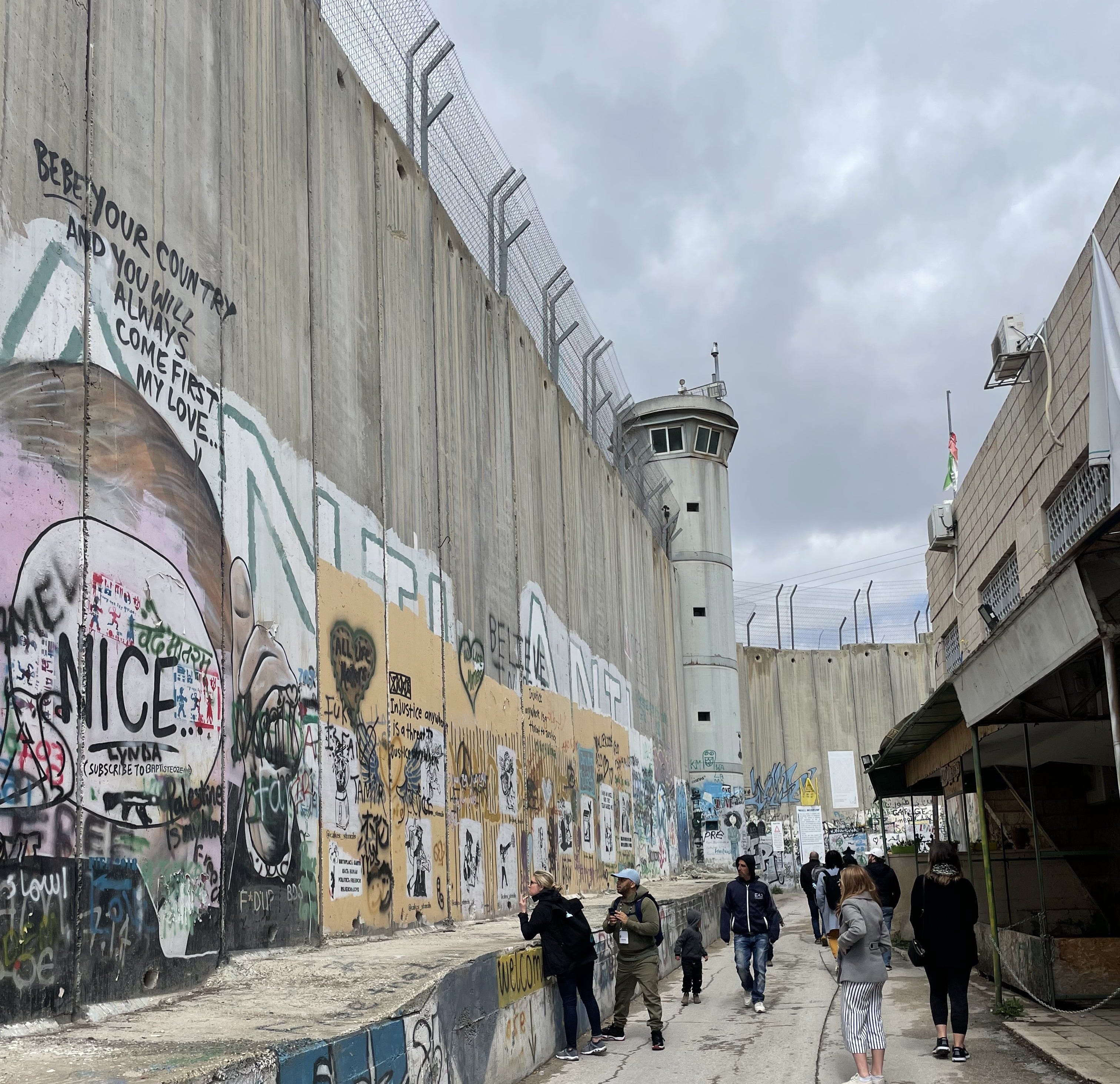
In early 2022, murals of George Floyd unfurled alongside Banksy’s famous images.
It was a moment of global turmoil.
That wall was not only a symbol of separation and detainment.
It had become a canvas for imagining something better.
It is a wall I hope to see fall in my lifetime.


Perhaps one day we will have a piece of it.
In the same way my father once brought home a piece of the Berlin Wall—an artifact that was once monumental, and later mistaken for detritus and thrown away.
I began that trip in the audience of a scholar of Middle Eastern geopolitics, seated before a map that stretched through Central Asia and North Africa. Places where history overlaps and collides.
“You must remember,” he said.
“That my enemy’s enemy is not my friend.
“Except for sometimes.”
A reminder that even strong positions sit on moving ground.
Readiness, it turns out, is not the same as knowing what comes next.
…
My work takes me into complicated places and conversations.
Holding two opposed ideas at the same time — and still functioning — has become less an intellectual exercise and more a requirement of daily life.

Subscribe, comment, or share if this resonates.
And reach out if you’re looking for thoughtful partnership around complexity, culture, and change.
you just poured my heart out for all to read
Te robo la imagen de la bailarina y el alambre espigado pintada sobre el muro 🤍